On Wednesday, July 8, three of Latvia's biggest fuel chains told the country that fuel was cheaper that day. Not the same week. The same day. Virši and Neste each ran a one day flash discount and promoted it with a dedicated Meta ad. Circle K ran the same play, "Šodien cenas lejā", a price drop valid at every station until 23:59, and announced it with an organic Facebook post and not a single paid ad behind it. I found the collision while lining up all four Latvian fuel chains we track through our MCP, and the gap between the three playbooks is the most instructive thing I have seen in the category this summer.
The same sale, three very different budgets
Virši's flash ad reached 79,970 people. Neste's reached 26,630. Circle K launched its price drop only organically, with zero paid activity behind it. Three brands, one identical tactic, and visibility that ranked exactly by how much paid delivery each one bought.
I double checked Circle K in the ad library through our MCP. Their entire active Meta lineup that week was food: every ad in the library from late June onward is a "Jebkura maltīte" meal combo creative, plus a set of B2B fleet card ads running since early June. There is no fuel price ad anywhere near July 8. A national price drop, arguably the most competitive message a fuel retailer has, went out with zero paid support while the brand spent its entire Meta budget on coffee and croissants.
A national price drop, arguably the most competitive message a fuel retailer has, went out with zero paid support while the brand spent its entire Meta budget on coffee and croissants.
The paid duel, three times the reach
Between the two chains that did pay, the fight looked even on paper. Same country, same product, same broad adult targeting (Virši ran 18 to 65, Neste 20 to 65, both nationwide Latvia). The result was still a three to one gap in attention.
The creatives were closer than the numbers suggest. Virši shouted "ŠODIEN (08.07.) IZDEVĪGI LABA CENA DEGVIELAI" and stapled on a giveaway: follow the page, comment your car's nickname, tag a friend, win a 50 euro gift card. Neste ran "Nestiņš ir klāt!", a friendly named discount day, 3 cents per litre off from 6:30 to 23:59 for anyone paying with the Neste Private Card or app. Both are competent flash sale ads. Only one of them got to compound.
The 24 hour head start
The daily delivery data explains most of the gap. Virši put its ad live on July 7, a full day before the sale, and banked 39,847 reach before the discount even started. On sale day it added another 40,123. Neste's ad went live on the morning of July 8 and collected its 26,630 in a single day of delivery.
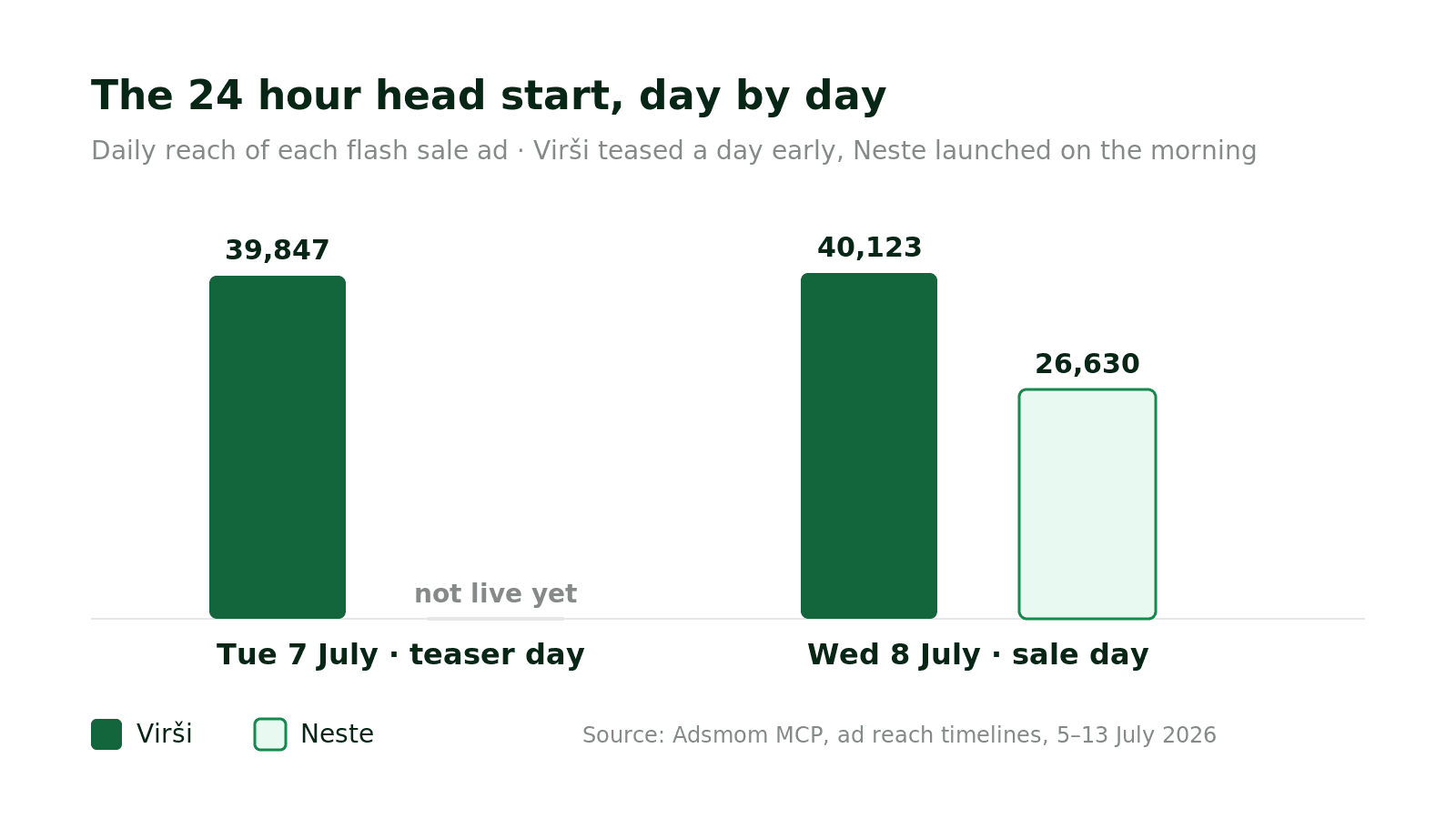
Look at just the sale day and the fight is much closer: 40,123 for Virši against 26,630 for Neste. The teaser day is almost the entire difference. Meta delivery ramps, and an ad that launches the morning of a one day event spends its only day of life warming up. I cannot see budgets from the outside, so I will not claim timing is the whole story. But the shape of the daily curves is hard to argue with: the chain that gave the algorithm a day of runway ended the duel with three times the audience.
There is a consolation stat for Neste. Their one day Nestiņš flash, at 26,630, nearly matched their best performing ad of the entire week, the evergreen Futura 98 campaign, which needed all 7 days to reach 28,911. Flash days work for them too. This one just got outgunned.
The rest of the forecourt
The weekly totals for the category make the story even more interesting. Virši led the market with 534,250 weekly reach from 13 new ads and an average of 30 active ads per day. Circle K Latvija reached 419,641 people while launching exactly zero new ads, riding creatives that are 25 to 42 days old. Its biggest ad, the "Jebkura maltīte. Jebkurā laikā." combo push at 3 and 4 euros, reached 143,778 people on its own. So Circle K clearly knows how to buy reach at scale. It simply chose to point all of it at food while its fuel sale rode organic. Neste came third at 321,923 despite running the most ads of anyone, an average of 58 active per day.
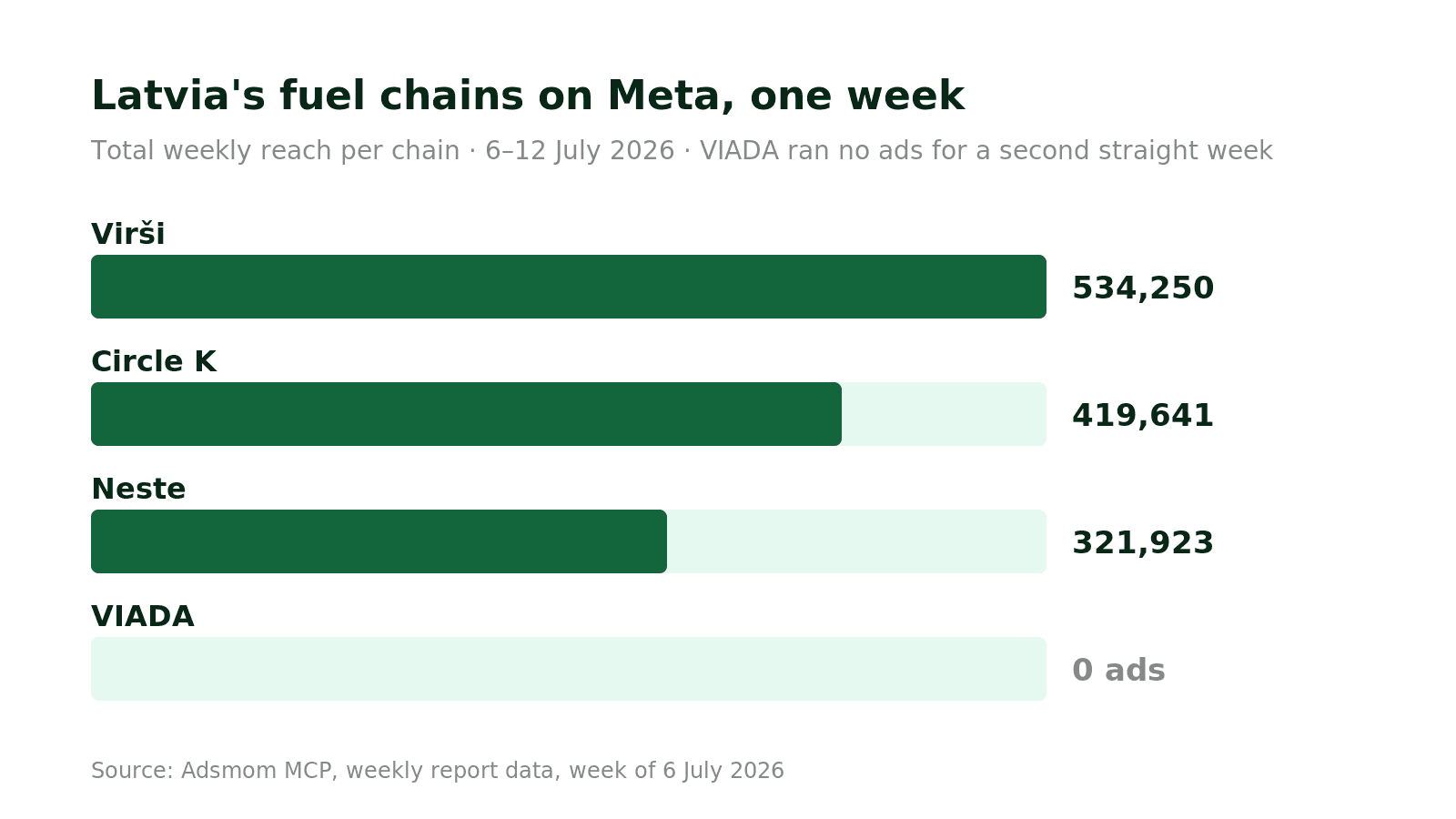
Then there is VIADA. Zero Meta ads for the second consecutive week, in the middle of peak summer driving season, while the three active chains stacked up a combined 1,275,814 in weekly reach. VIADA has 46,000 plus organic followers and a loyalty app partnership to lean on, but in the paid feed the brand simply does not exist right now.
What I take from this
Flash sales are won before they start. If your offer lives for one day, your ad cannot be one day old. Give delivery a teaser day, let the system find your audience, and the sale day becomes harvest instead of ramp up.
The second lesson is about watching the calendar, not just the creative. Three rivals picked the same flash day and only one of them, as far as the feed shows, saw the others coming. If Neste had known on July 7 that Virši was already teasing a July 8 discount, would they have moved their Nestiņš day? And if Circle K saw two paid campaigns lining up against its organic post, would it have put even a small budget behind the most competitive message it had all week? That is exactly the kind of question you can now answer on a Monday morning. Pulling this whole comparison, four weekly reports, two ad level reach timelines and the creative details behind them, took a few minutes through the Adsmom MCP inside a single chat.
Adsmom MCP lines up every competitor's live Meta, TikTok and Google ads and their daily reach curves in one chat. Pulling four weekly reports and two ad level timelines for this post took a few minutes on a Monday morning.
See Adsmom MCP