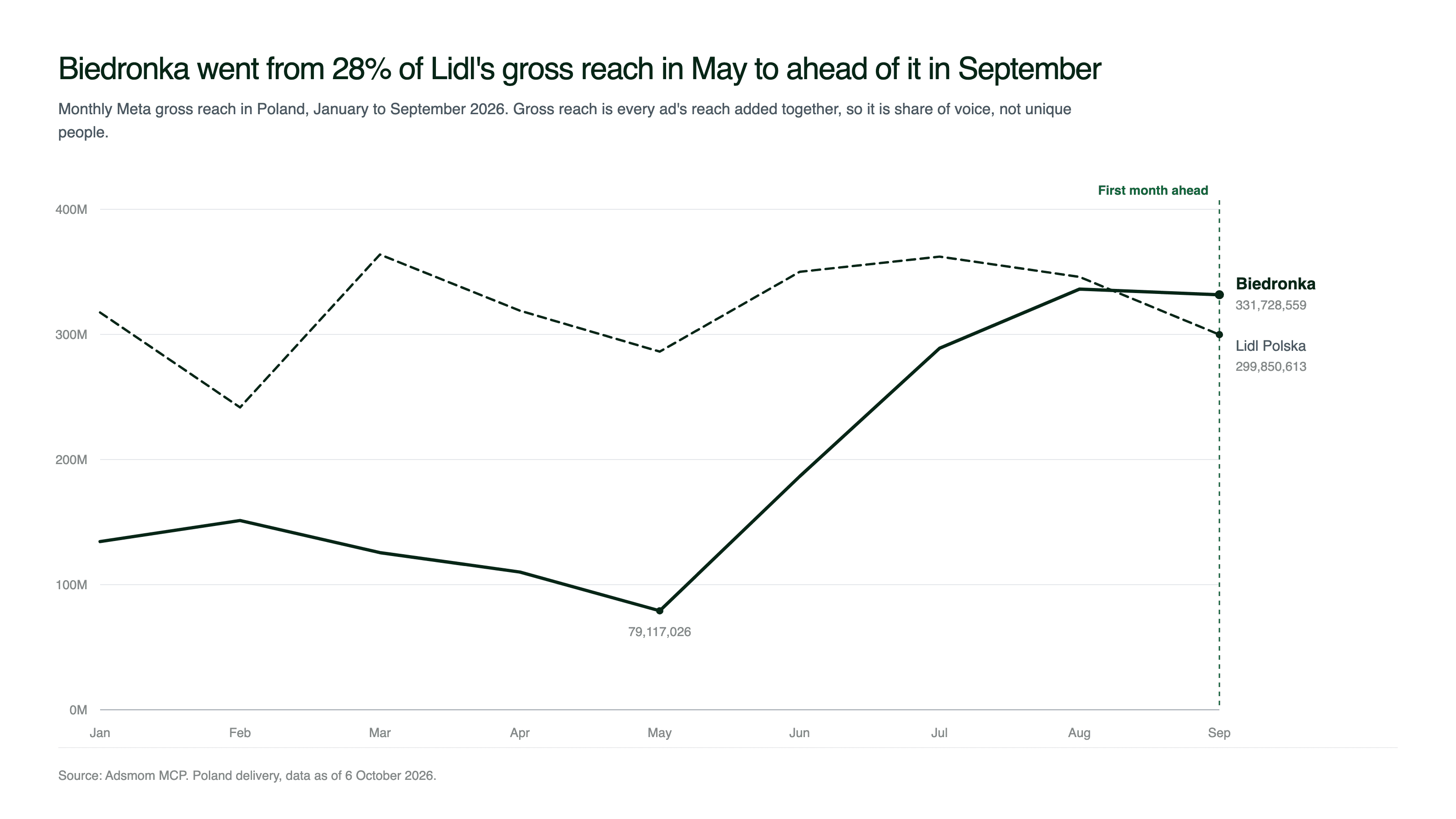
I asked Adsmom's MCP for nine months of monthly Meta gross reach across the nine biggest grocery chains in Poland. One prompt. Gross reach is every ad's reach added together, so it is share of voice, not a count of people. The two lines that matter are Biedronka and Lidl Polska, and they cross in September. In May, Biedronka's gross reach on Meta was 79,117,026 against Lidl's 286,280,764, which is 28% of its rival. In September it was 331,728,559 against Lidl's 299,850,613. That is the first month in 2026 that Biedronka has been ahead.
Lidl did not lose. Biedronka won.
The first thing to rule out is a Lidl retreat, and the data rules it out quickly. Lidl Polska's monthly gross reach ran between 241,666,389 and 363,844,419 all year, with no trend. Its average active ads per day was 203 in March and 192 in September. Its new ads per month stayed in a band from 372 to 709. September was a slightly soft month for Lidl, down from 345,992,350 in August, but August was a month it still won.
Biedronka is the one that changed. It had a quiet first half, drifting down from 134,478,430 in January to a low of 79,117,026 in May. Then June doubled to 186,516,314, July hit 288,971,349, August 336,220,378, and September held at 331,728,559. Four months, a 4.2 times increase, and it never gave any of it back.
The machine behind it
The step change is visible in one number. Biedronka launched 318 new Meta ads in June. In July it launched 1,029. August was 932 and September 939. It tripled its creative output in a single month and has kept that pace for three. Lidl's new ad count moved from 391 in June to 437 in July to 503 in September, which is a normal range for Lidl.
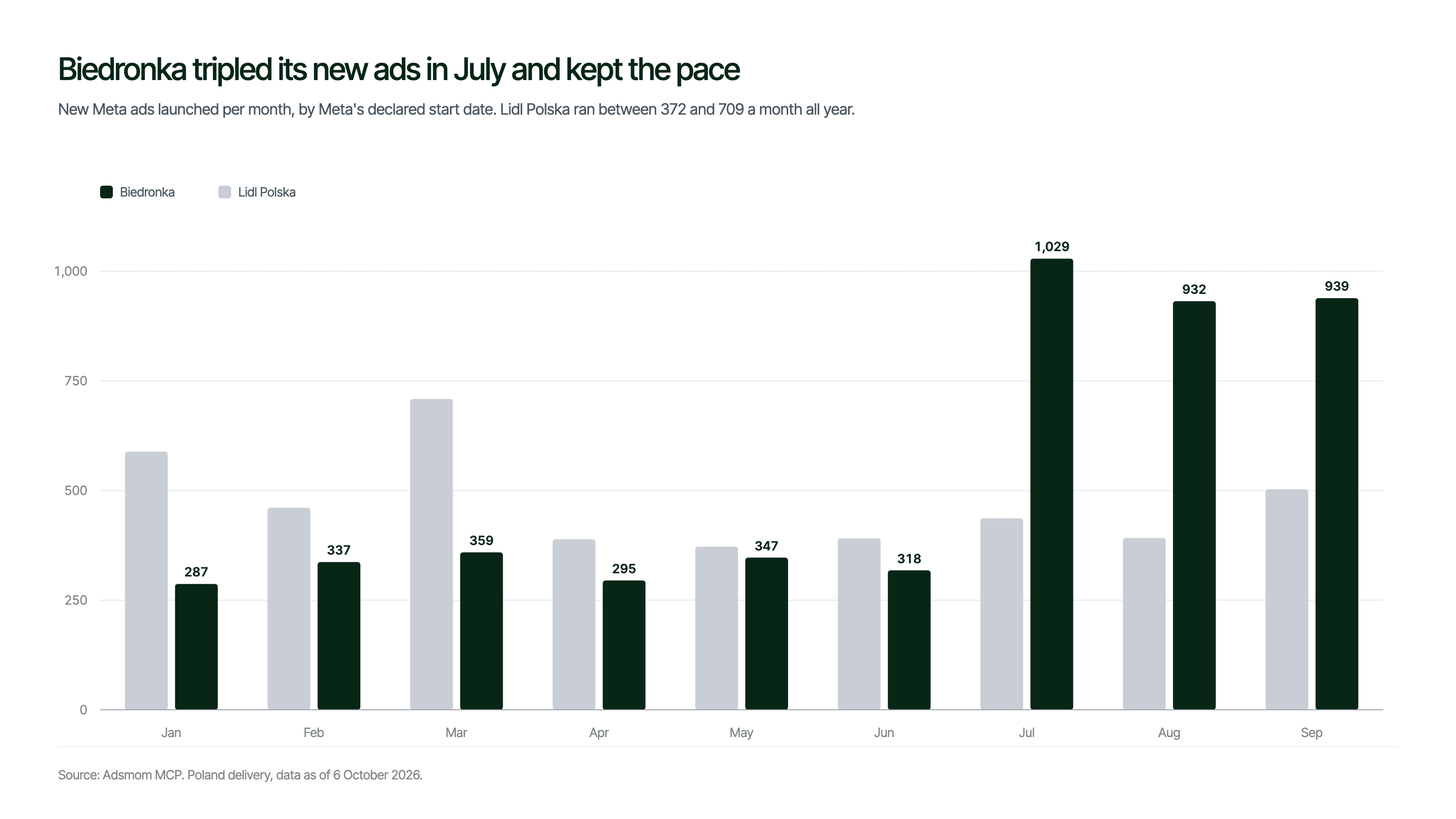
Gross reach moved before volume did. June doubled on roughly the same number of new ads, which looks like a budget decision on existing creative. July added the volume on top. Over the five weeks from 1 September Biedronka had 1,046 ads live and 1,043 of them were new in the window, so it is effectively replacing its whole portfolio every month. Its average active ads per day went from 64 in March to 118 in September, while Lidl's went from 203 to 192.
Two opposite playbooks
What makes this more than a budget story is that the two accounts are built differently. Rank every ad from both pages since June by its own reach and Lidl owns 17 of the top 20. Its biggest ads are weekly offer videos, most of them under one headline, "Sprawdź Lidlowe okazje!", each reaching 7 to 8.7 million people. Lidl is a peaks account. In September, 69% of its gross reach came from video and the top 5% of its ads carried 45.6% of everything.
Biedronka is a breadth account. Of its 1,045 September ads, 934 were image ads and they carried 83.7% of its gross reach. The top 5% carried 32.3%. Its biggest single ad of the month reached 6,618,360, smaller than Lidl's 7,923,467, and it won the month anyway because the next 900 ads did the work. Biedronka's biggest ad of the summer was not an offer at all. It was the Złoty Pazur cat drama video at 9,700,423, followed by the Gang Zaradniaków collectible mascot campaign at 7,160,367 and a 35 zł voucher mechanic at 6,895,534.
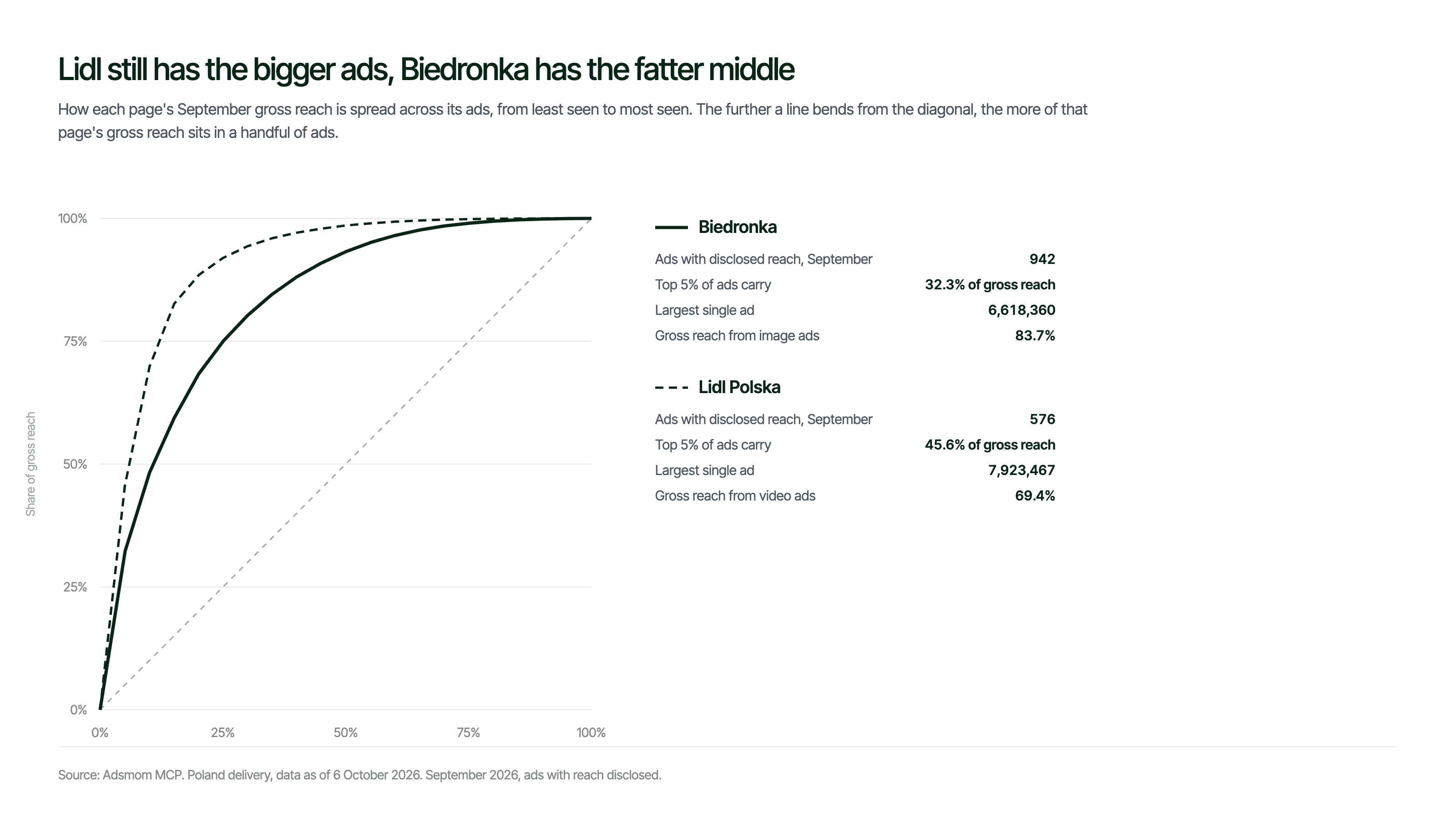
Lidl still has the bigger ads. Biedronka has the fatter middle, and in September the middle won.
What it did to the rest of the market
Across nine national chains, Lidl held 43.4% of grocery share of voice in the five weeks from 1 March and Biedronka 14.4%. In the five weeks from 1 September, Biedronka held 36.3% and Lidl 33.6%. Between them the two discounters now take 70% of the category's gross reach on Meta, up from 58%.
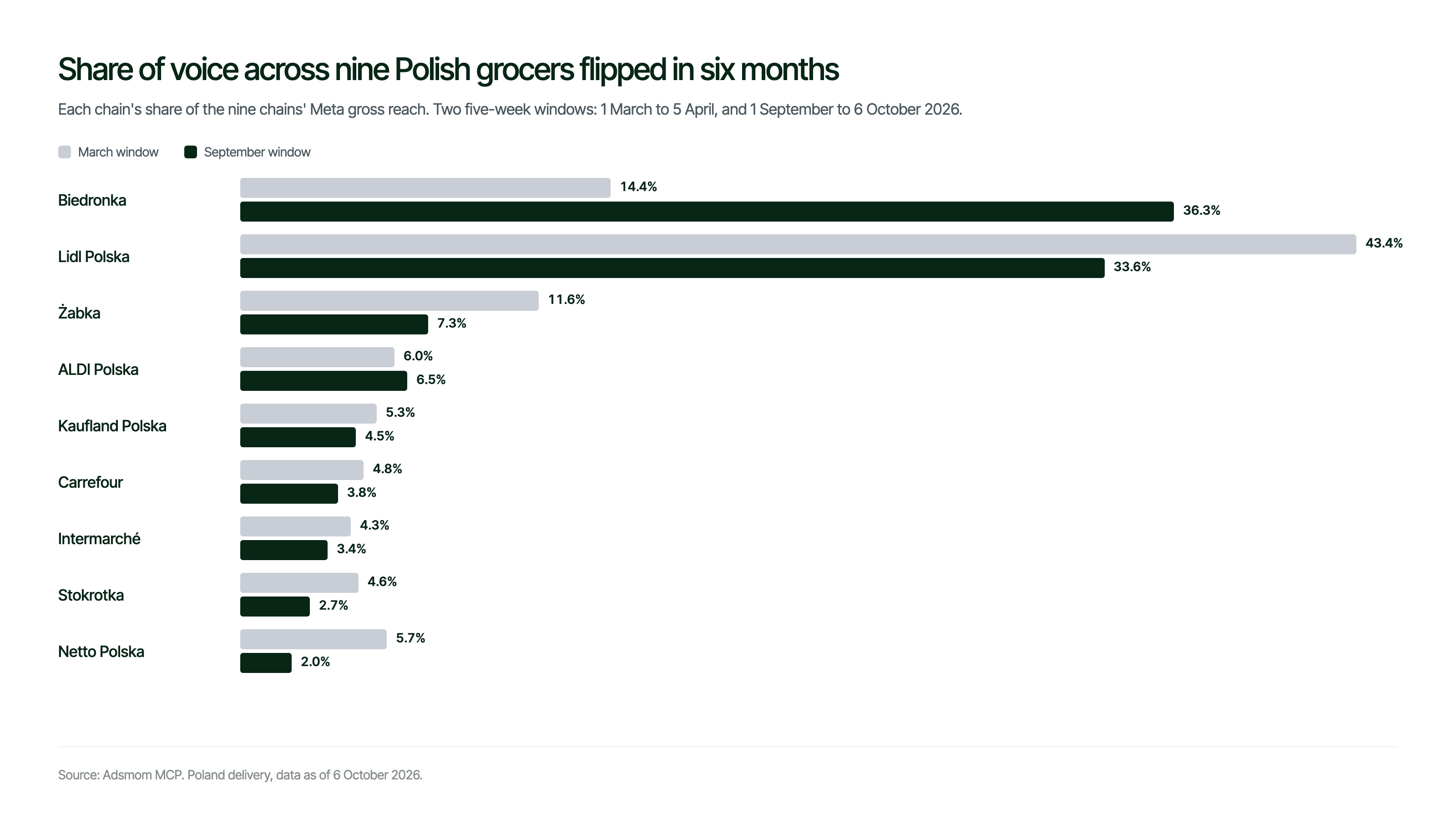
The squeeze landed on the mid-sized chains. Netto Polska went from 5.7% to 2.0% and its monthly gross reach halved between January and September. Żabka fell from 11.6% to 7.3%. Kaufland Polska lost a third of its monthly gross reach over the year. ALDI Polska was the only other chain to hold its ground, at 6.0% and then 6.5%.
One more shift inside Biedronka's own numbers. Its gross reach was 56.5% female in the March window and 63.1% female in September. Lidl stayed 53% male across both. The two biggest grocery advertisers in Poland are now talking to different people as well as at different volumes.
What I would take from it
If you buy media against either of these two, the competitive picture you had in spring is wrong. The category leader on Meta changed in September, and it did not change because the leader got weaker. A monthly share of voice line is the only thing that catches that early; a one-off snapshot in May would have told you Biedronka was a distant second and fading.
The usual caveats. Gross reach is Meta's per-ad reach summed across an account's ads, so it is share of voice rather than a count of unique people, and the same person is counted once for every ad that reached them. It is gross reach, not spend, so I cannot say what either chain paid for it. And it covers the pages we track, which for Poland is fourteen grocers, nine of them in the share table above.
Adsmom Insights tracks monthly share of voice, new ad velocity and gross reach concentration for any competitive set. Nine Polish grocers, nine months, four charts, one prompt.
See share of voice